1976 ad recalls cheaper prices, layaway, and family hunting traditions!
Fifty-year-old ad recalls lower prices, layaway plans and firearms that became family treasures.
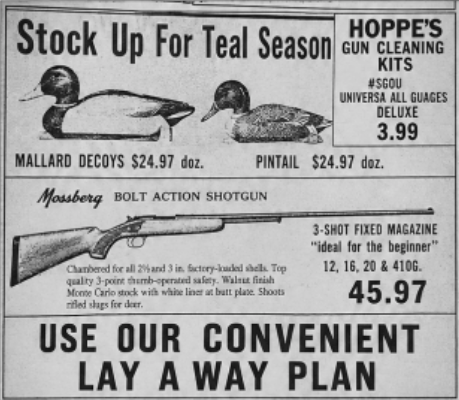
A September 1976 newspaper advertisement invited Avoyelles Parish hunters to “Stock Up for Teal Season.” Mallard and pintail decoys were advertised for $24.97 a dozen. A Hoppe’s gun-cleaning kit cost $3.99. The largest item in the ad was a three-shot Mossberg bolt-action shotgun priced at just $45.97.
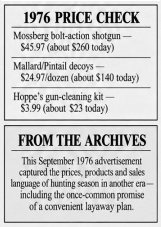
That number is enough to make almost any hunter look twice today. However, $45.97 represented considerably more buying power in 1976 than it does now. Adjusted for inflation, the shotgun would cost roughly $260 today. The $24.97 dozen of decoys would be about $140, while the $3.99 cleaning kit would equal approximately $23.
In other words, hunting equipment was certainly cheaper on the price tag, but it was not always as inexpensive as it first appears when compared with the wages and household budgets of the time.
The shotgun advertised in 1976 was simple and practical. It held three shells and featured a walnut-finished Monte Carlo stock, a thumb-operated safety and the ability to shoot rifled slugs for deer. Bolt-action shotguns are far less common on store shelves today, where pump-action and semi-automatic models dominate.
Has the quality changed over the past 50 years? The answer depends on what a hunter values. Many older firearms were built with substantial wood and steel parts and relatively simple mechanisms. Their weight, solid feel and traditional appearance are part of their appeal. If properly cleaned and stored, many remain dependable decades later.
Modern firearms offer advantages of their own. Synthetic stocks are lighter and more resistant to rain and humidity, an important consideration during a Louisiana hunting season. Modern coatings provide better protection against rust, and today’s hunters can choose from a wide range of sights, recoil pads, chokes and other features.
Newer does not automatically mean better, and older does not necessarily mean stronger. A firearm’s condition often depends more on how it was used, cleaned and stored than on the year it was manufactured.
One of the most noticeable lines in the old advertisement has little to do with the shotgun itself: “Use our convenient layaway plan.” Before credit cards and online payment services became part of everyday shopping, layaway allowed a customer to select an item and pay for it a little at a time. The store held the purchase until the final payment was made.
Layaway has not disappeared completely, but it is far less visible than it once was.
A father might have placed that $45.97 shotgun on layaway in September, made payments from several paychecks and brought it home before deer season or perhaps saved it for a Christmas gift.
That same shotgun may still be in an Avoyelles Parish gun cabinet today, passed from a father or grandfather to the next generation. After 50 years, its stories and family memories may matter more than its monetary value.
Some grandfathers still put aside a firearm for each grandson, knowing that one day those guns will be passed down with a lifetime of memories.
Take another look at the older firearms in your family. Was one purchased from an advertisement like this? Was it placed on layaway? Who carried it first, and who will carry it next? That $45.97 shotgun may have become something no store can sell today: a family treasure.
Comments ()