Avoyelles Cannot Build Its Economy Backward
By Dr. Jay Callegari
Avoyelles Today recently asked residents what they thought about the possibility of a data center locating in Avoyelles Parish. Many of the responses were strongly opposed. The newspaper then asked a reasonable follow-up question: If we do not want a data center, what kind of business or industry do we want?
The answers included a Rouses, Aldi, Trader Joe's, Buckee’s, steakhouse, clothing stores, miniature golf, bowling, restaurants and family entertainment. Others suggested manufacturing, distribution centers, agricultural processing, oil and gas development and even a steel mill.
There is nothing wrong with wanting better stores, restaurants and entertainment. I want those things too. However, many of us are trying to build the economy backward.
A supermarket, bowling alley or nice restaurant normally does not enter a struggling community and make that community prosperous. Those businesses come after there are enough people earning enough money to support them. A restaurant cannot survive on Facebook comments saying how nice it would be to have one. It needs customers with disposable income throughout the week.
These businesses mostly depend on money already circulating inside Avoyelles Parish. The industries that come first are the ones that bring new money into the parish through manufacturing, processing, logistics, energy, technology or services sold outside the local area. Those operations create wages, contracts and tax revenue. The people earning that money then support grocery stores, restaurants, entertainment and other local businesses.
One business creates the paycheck. The other gives people somewhere to spend it.
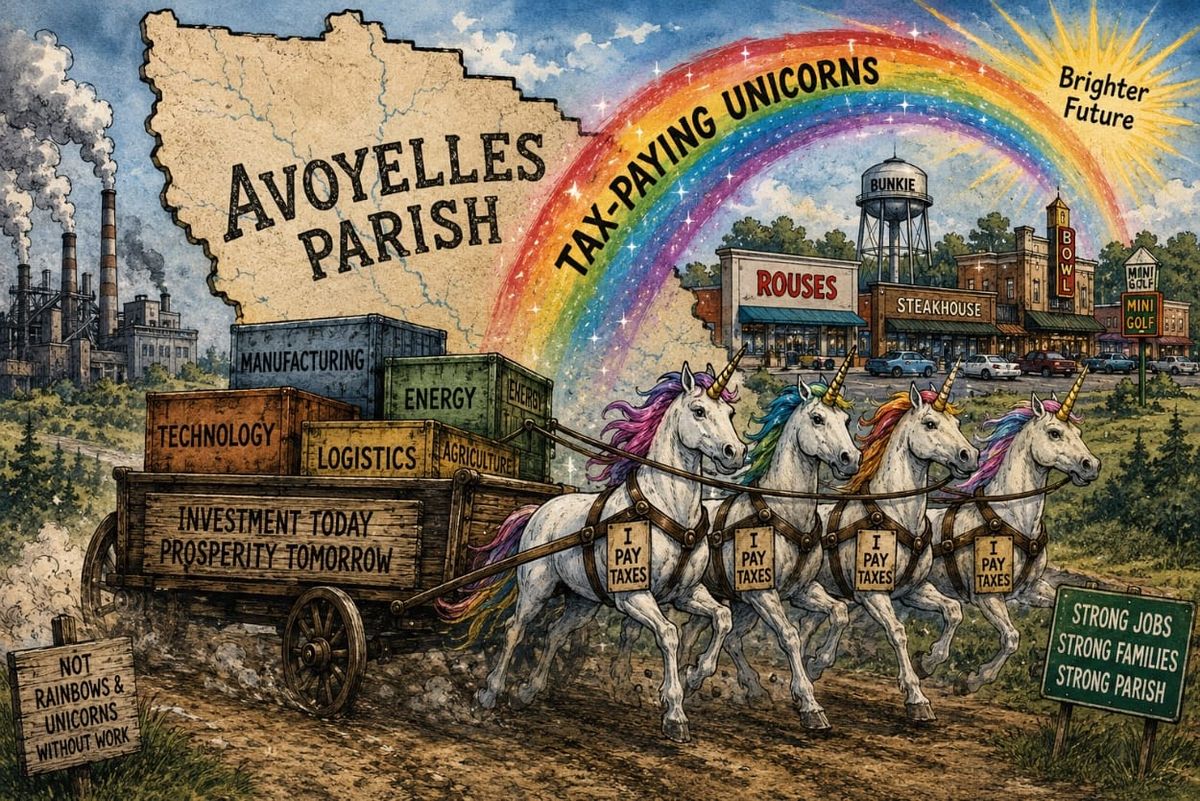
That does not mean Avoyelles Parish should accept every proposal that comes along. It does mean we have to understand that every serious industry will bring some disadvantage along with the benefits. We seem to be holding out for a company that pays $30 an hour, uses no water, draws no electricity, creates no traffic, makes no noise, produces no waste and arrives in Avoyelles Parish on a rainbow pulled by tax-paying unicorns. That company does not exist.
A warehouse brings trucks. A food-processing operation may bring odors and wastewater. A sawmill creates dust and noise. Oil and gas development has environmental risks. Manufacturing may involve chemicals, heavy equipment and emissions. Even a large retailer can create traffic, pay relatively modest wages and send much of its profit outside the parish.
Every Industry Has a Downside
Several commenters suggested a steel mill. A steel mill could create good jobs, but it carries far greater traditional industrial concerns than a building filled mainly with computer servers. The EPA maintains extensive wastewater and air-emission regulations for iron and steel manufacturing because those facilities can discharge industrial wastewater and emit regulated metals and other hazardous pollutants. (U.S. Environmental Protection Agency)
That does not mean a steel mill would automatically be bad. It means we should not reject one industry because of possible impacts and then name another industry without recognizing its own impacts. Every proposal must be judged by what it actually brings, what it costs and whether its risks can be controlled.
Electricity Is the Real Data Center Question
With data centers, the largest legitimate concern is electricity. The U.S. Department of Energy reports that data centers used approximately 4.4 percent of all electricity consumed in the United States in 2023, and their share could rise to between 6.7 and 12 percent by 2028. (U.S. Department of Energy)
That level of demand should concern us. A large data center may require additional generation, transmission lines, substations and other expensive infrastructure. Avoyelles Parish residents and existing businesses should not be forced to pay higher electric rates because a multibillion-dollar company needs additional power.
Before supporting such a project, parish leaders should insist that the company and electric provider explain who will pay for the necessary infrastructure, how ordinary customers will be protected and what happens if the project closes, scales back or never reaches its promised size. A data center should pay its own way, and the people already living and doing business in Avoyelles Parish should not be left with higher rates or stranded costs.
A major government review in Virginia recommended planning specifically for the danger that expensive infrastructure built for data centers could become stranded and leave existing customers responsible for the cost. (Virginia Joint Legislative Audit and Review Commission)
This concern is not limited to other states. In a filing before the Louisiana Public Service Commission, the Louisiana Energy Users Group supported large-load economic development but argued that it must be structured to protect existing ratepayers and avoid placing the financial risks of new power generation on them. (Louisiana Public Service Commission filing)
That should be the position of Avoyelles Parish. We should not simply say no because a data center uses a great deal of electricity. We should say that the company must pay its own way and that our residents must be protected from higher rates.
Toxicity and Noise
There have also been claims that data centers are highly toxic. That description is exaggerated. A data center is not a refinery, chemical plant or steel mill. Its environmental concerns generally involve the electricity used to operate it, cooling equipment, fuel storage and the diesel or natural-gas generators used during outages and testing.
Those generators do produce emissions, and they must be properly permitted and regulated. The EPA applies federal air-pollution standards to the stationary engines and turbines commonly used for primary and backup power at data centers. However, the danger comes from ordinary combustion equipment and fuel handling, not computer servers constantly releasing mysterious toxins into the community. (U.S. Environmental Protection Agency)
The humming noise is a more legitimate concern, but it depends greatly on where the facility is placed and how it is designed. Cooling equipment, fans and transformers can create a continuous low-frequency hum. Virginia's extensive study found that this noise is generally not loud enough to damage hearing and that most data centers do not generate complaints, although it acknowledged that noise has affected some nearby residents when facilities were poorly located or designed. (Virginia Joint Legislative Audit and Review Commission)
That is why location matters. Avoyelles Parish should require appropriate setbacks from homes, schools and churches, sound modeling before construction and testing after the facility begins operating. Noise barriers, enclosed equipment and enforceable nighttime sound limits should be part of any agreement.
We Cannot Reject Everything
That is how mature communities handle development. They identify the problems, establish protections and negotiate a better deal. They do not automatically accept everything, but they also do not immediately reject everything.
We cannot complain that our children must leave Avoyelles Parish to find good jobs and then form a Facebook firing squad every time someone discusses bringing a serious employer here. Asking hard questions is responsible. Demanding protections is responsible. Rejecting a bad proposal after studying the facts is responsible. Rejecting every proposal before the facts are known is not.
Perhaps a particular data center would not be right for Avoyelles Parish. It might demand too much electricity, offer too few permanent jobs, seek too many tax incentives or be proposed for the wrong location. If the numbers do not work, we should say no.
But if we say no to every industry because it has some risk or inconvenience, the result will not be a perfect, harmless industry. The result will be no industry.
Then we will continue asking why better grocery stores, restaurants and entertainment businesses do not locate here. They are not waiting for an invitation. They are waiting for customers who have enough money to support them.
Avoyelles Parish must decide which impacts we are willing to manage and what protections we will require. We should be cautious and selective, but we cannot be afraid of everything.
Growth has a price, but stagnation has a price too. Avoyelles Parish has been paying that price for years through limited opportunities, weak infrastructure, population loss and young people building their futures somewhere else.
We cannot build our economy backward, and we cannot have the benefits of growth while refusing every difficult decision required to achieve it.



Comments ()