Coreil’s Career Corner: Working offshore during the summer of 1974
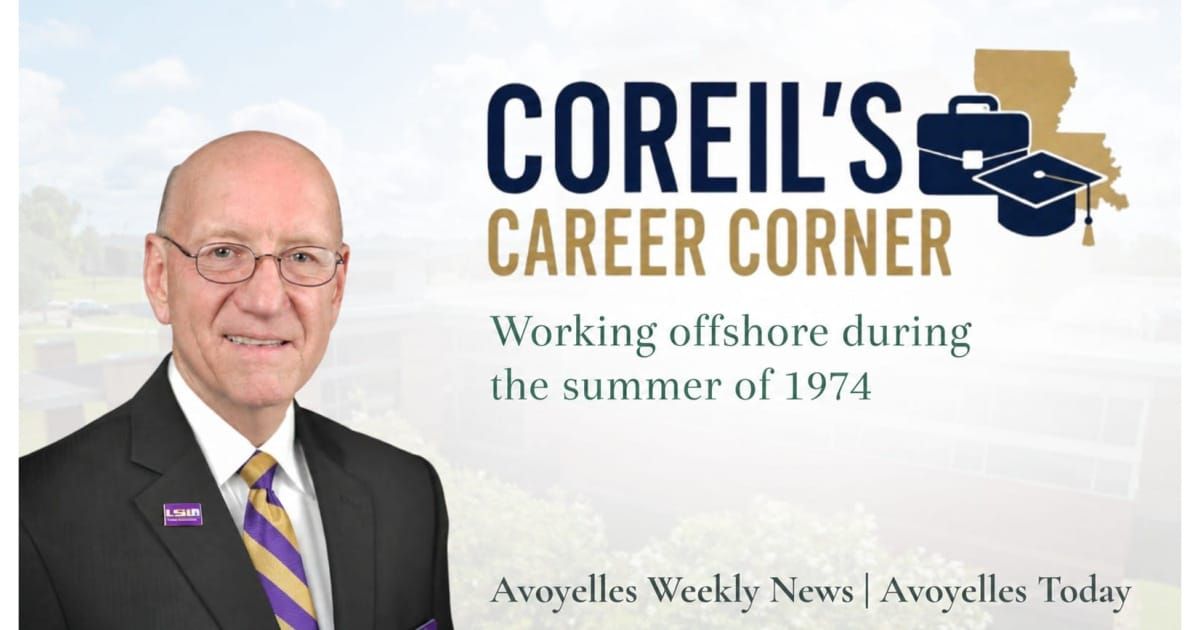


By Dr. Paul Coreil
In 1974, I proposed to my high school sweetheart, Arlene Pitre, and thankfully, she said yes! We were just finishing our first year at the University of Southwestern Louisiana (USL) (now ULL) in Lafayette, and we made plans to be married on August 17 at Our Lady of Wisdom Catholic Chapel on the university campus.
With great excitement, we began making detailed plans for our life together. One of our first priorities was finding a place to live. We were fortunate to secure an apartment in “Vet Village,” the married-student housing area on campus. The name reflected its history of housing veterans of World War II and the Korean War who had returned to college after their military service.
Of course, getting married required more than love and excitement. It also required money!
Our parents provided some financial assistance, but Arlene and I knew we would have to shoulder much of the cost of the wedding and establishing our new household. We both had student jobs on campus, but those jobs would not provide enough money to cover the wedding expenses and purchase the furniture and appliances we needed for our new apartment.
Arlene’s campus job was in the same building as the university office responsible for married-student housing, so her knowledge of the housing application and assignment process certainly helped us secure our apartment. I also decided not to attend summer school the summer of our wedding so I could find a better-paying job and save as much money as possible.
That decision led me offshore.
I was hired by a food-service company that provided food and custodial services for oil-drilling rigs operating in the nearshore waters off the Louisiana coast. My job was as a galley hand, working a seven-days-on, seven-days-off schedule, with 12-hour shifts each day.
The work was demanding. I helped the cooks prepare and serve three full meals a day for the entire rig crew. I worked with both the day and night cooks because meals had to be served around the clock. In addition to kitchen duties, I washed dishes and pots, made beds, swept and mopped floors, cleaned bathrooms and performed just about any other task necessary to keep the crew comfortable.
The pay was good for a young college student. I received overtime pay at time-and-a-half after 44 hours in a week. With a typical schedule of 44 regular hours and 40 overtime hours, I was able to earn a substantial amount of money each week—money that I desperately needed for our upcoming wedding and new life together.
Life on an offshore drilling rig was unlike anything I had experienced before. The Tool Pusher was the senior supervisor and was responsible for the day-to-day drilling operations, equipment and drilling crews. Although I officially worked for the food-service company, everyone on the rig ultimately answered to the Tool Pusher.
I sometimes thought of him as the “mayor” of the rig. The rig was essentially a small, over-the-water community where everyone worked, ate and slept during their seven-day shifts.
One evening, after completing a long 12-hour shift, I was relaxing in a large common room where crew members often gathered to watch television and unwind. The room was dimly lit, and several men were settling down after finishing their shifts.
After sitting on the couch for about an hour, I went to bed, completely unaware that my wallet had fallen out of my back pocket and become lodged beneath one of the couch cushions.
The next morning, I realized my wallet was missing. I immediately returned to the common room and searched the couch. I found my wallet underneath the cushion—but all the cash was gone.
I was devastated.
That money represented weeks of hard work and was money I had been carefully saving for our wedding. Losing it so close to August 17 was more than a financial setback; it was a personal crisis for a young college student trying to start a marriage.
I immediately reported the theft to the Tool Pusher. He recognized how important that money was to me and told me he had an idea that might help recover it.
He announced over the rig’s intercom that a wallet had accidentally fallen from someone's pocket while sitting on the couch. He explained that the wallet had been recovered, but the cash inside was missing. He then announced that the wallet would be sent by crew boat to the Louisiana State Police for fingerprint identification.
Then came the part that got everyone's attention: no one would be allowed to leave the rig until the money was returned!
I was extremely appreciative of his willingness to be so helpful. At the same time, I was certainly hoping his plan would work.
There was, of course, one small detail I didn't know at the time: there were no actual plans to send my wallet to the Louisiana State Police.
The Tool Pusher had created a story designed to convince whoever had taken the money that there was a very real possibility of being identified. And apparently, his strategy worked.
The next morning, for reasons I still cannot explain, I decided to lift the same couch cushion where my wallet had been found.
To my astonishment, there was my money!
Every dollar that had been taken from my wallet had been returned and was lying underneath the cushion.
I immediately went to find the Tool Pusher and told him the good news. I thanked him for his brilliant plan and for caring enough to help a young college student recover the money he needed for his wedding.
He then made another announcement over the rig's intercom. He informed everyone that the missing money had been returned and that the request for fingerprint identification by the Louisiana State Police had been cancelled.
I will never forget that experience—or the ingenuity and compassion of the Tool Pusher who came to the aid of a young man trying to make his wedding day possible.
Looking back, my summer of working offshore in Vermilion Bay was much more than a way to earn money for a wedding. It became one of those unique life experiences that stayed with me forever. It taught me something about hard work, the challenges of starting a family and, most importantly, how one person's willingness to help can make a tremendous difference in someone else's life.
That summer of 1974 eventually led to August 17, when Arlene and I were married. More than five decades later, we can still look back and smile about those early days—and especially the summer when a young college student worked offshore on an oil rig to help prepare for his wedding.
Our wedding anniversary has now reached 52 years, and that experience remains one of the many stories we cherish when remembering the beginning of our life together.
An amazing experience that ended well! Until next time, Paul Coreil

Comments ()