Experiences with white alligators in Louisiana
COREIL’S CAREER CORNER
Stories, lessons and career insight from Dr. Paul Coreil
BY DR. PAUL D. COREIL
During my career with the Louisiana Cooperative Extension Service, I had the opportunity to work with many of Louisiana's fascinating wildlife species. But few experiences were as unusual or as memorable as the opportunity I later had to work with some of the world's rarest alligators: Louisiana's beautiful, blue-eyed white alligators.
In 1998, after 25 years with the Louisiana Cooperative Extension Service, I accepted a position with Burlington Resources in Houma, as Wetlands Resources Manager. It was an exciting career transition that took me from public-sector Extension work into the management of one of Louisiana's most valuable private coastal wetland holdings.
At the time, Burlington Resources had recently acquired the Louisiana Land & Exploration Company (LL&E), one of the state's most historic land and natural-resource companies. LL&E had accumulated enormous holdings of Louisiana coastal marshland and had been involved in oil and gas, land management, wildlife, hunting, trapping and other natural-resource enterprises for decades.
Following the acquisition, Burlington continued to manage more than 600,000 acres of coastal wetlands. These lands were incredibly rich in natural resources and supported abundant waterfowl, recreational and commercial fishing, fur trapping and alligator populations. The company also generated revenue from hunting leases and other wildlife-related surface land activities.
My responsibilities included helping manage the company's commercial alligator program, which included the tag distribution and harvest of approximately 1,700 alligators, which were distributed among commercial alligator hunters who generally worked on a percentage-of-sales arrangement for the hides. At that time, alligator hides were still the primary commercial product, while the value and utilization of alligator meat had not yet reached the level it would in later years (see one of my previous articles related to alligator meat promotion).
But, among all the alligators associated with these vast coastal properties, there was one group that was truly extraordinary.
The famous
white alligators
Several years before I joined Burlington Resources, something remarkable had occurred on former LL&E property near Houma.
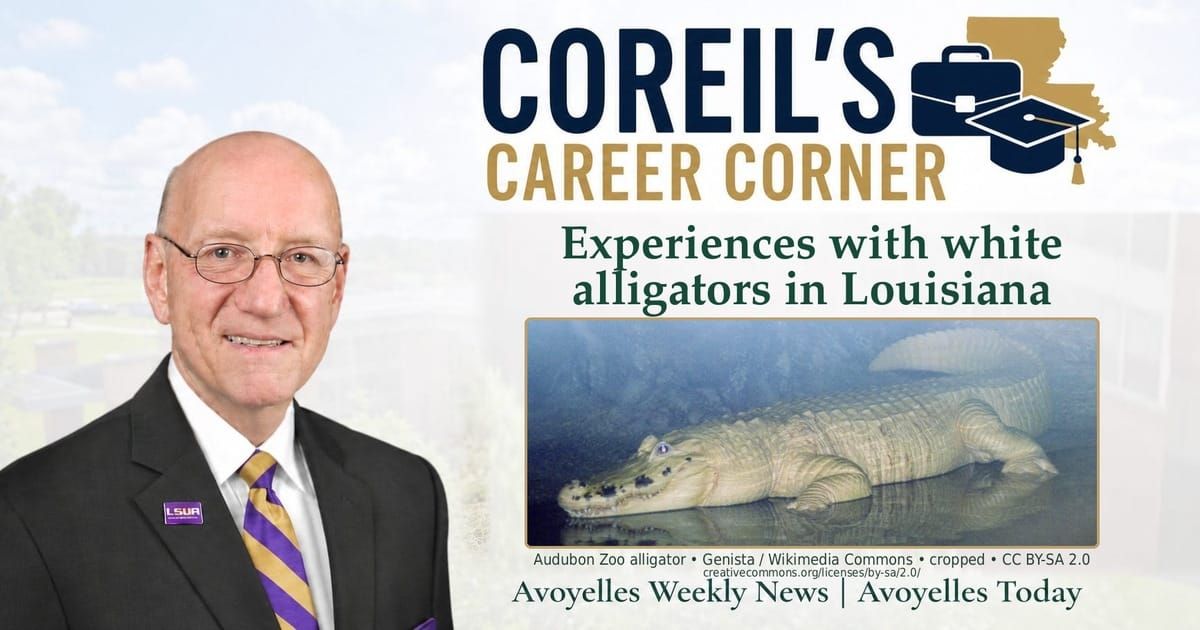
In late August 1987, a clutch of unusually colored American alligators was discovered in the coastal marshes of Terrebonne Parish. Eighteen white hatchlings were eventually documented from the remarkable clutch. Unlike normal dark-colored American alligators, these young reptiles had translucent white skin and striking blue eyes.
These were not albino alligators.
They were leucistic alligators, a rare genetic condition involving a significant reduction or absence of normal skin pigmentation. The distinction is especially noticeable in their eyes. leucistic alligators retain pigmentation in their eyes, giving them their characteristic deep blue or crystal-blue appearance. Albino animals, by contrast, lack pigmentation and typically have pink or reddish eyes.
Audubon Nature Institute continues to identify its famous white alligators as leucistic rather than albino.
That distinction may sound technical, but seeing one of these animals in person makes it unforgettable.
I remember the first time I saw them at the Burlington alligator facility in Golden Meadow. Their appearance was almost surreal. Their brilliant white bodies and blue eyes made them look more like something from a storybook than a Louisiana marsh.
And there was an important reason these animals could not simply be released into the wild.
A normal alligator's dark coloration provides excellent camouflage in Louisiana's marshes, ponds and bayous. A bright-white alligator has almost no such protection. As a hatchling, it would be highly visible to predators and would have difficulty approaching prey without being detected. The white coloration also makes it much more vulnerable to the intense Louisiana sun. For these reasons, the chances of a leucistic alligator surviving naturally in the wild are extremely poor.
That made the discovery of an entire clutch of 18 white hatchlings even more remarkable.
From LL&E to
Burlington Resources
The white alligators became something of a legend associated with LL&E. Some were placed with the Audubon Zoo in New Orleans, while others remained under L, L&E's care at its alligator facilities, including the Golden Meadow operation.
Historical records document that the original group attracted national attention and became one of the most unusual wildlife stories ever associated with Louisiana.
When Burlington Resources acquired LL&E in 1997, the company inherited not only enormous coastal land holdings (over 600,000 acres of marshlands) but also responsibility for these unusual animals.
Burlington was, first and foremost, an oil and natural-gas company. Operating an alligator facility was not a major part of its business mission, so eventually a decision had to be made about the future of the white alligators.
By the early 2000s, the remaining animals associated with the former LL&E operation were transferred to the care of the Audubon Nature Institute. Historical accounts indicate that 12 of the remaining leucistic alligators were donated to Audubon around 2001 as the private alligator operation was being phased out.
Today, Audubon continues to share the story of these remarkable animals with the public. The white alligators can be seen at the Audubon Zoo and Audubon Aquarium, where they serve not only as an extraordinary attraction but also as ambassadors for Louisiana's remarkable wildlife heritage.
Different white alligator
in Avoyelles Parish
Louisiana's fascination with white alligators continues today.
In July 2026, two rare albino alligator sisters named Snow and Winter were introduced at Paragon Casino Resort in Marksville. Unlike the famous blue-eyed leucistic alligators associated with LL&E and Audubon, these animals are true albinos. Their lack of pigmentation gives them the characteristic light-colored appearance and reddish or pinkish eyes associated with albinism. Paragon's July 25 introduction also highlighted the cultural significance of the alligator to the Tunica-Biloxi Tribe of Louisiana.
Their arrival provides an excellent opportunity to see the difference between two extraordinary genetic conditions. Leucistic alligators have white skin but retain eye pigmentation, producing their famous blue eyes. Albino alligators lack pigmentation altogether and have pink or reddish eyes.
Both are exceptionally rare.
A career experience
I will never forget
During my years with Burlington Resources, I had the privilege of helping manage several of the famous white alligators at the company's Golden Meadow facility. I had worked with wildlife for much of my professional life, but these animals were unlike anything I had encountered before.
They were beautiful, unusual and almost impossible to forget.
Looking back, the experience also reminded me of one of the reasons I chose wildlife management as a career in the first place. Louisiana's natural resources continually surprise us. From the vast coastal marshes and their abundant alligator populations to a single extraordinary nest containing 18 white hatchlings, our state's wildlife can produce discoveries that seem almost impossible.
The story of Louisiana's white alligators is therefore much more than a story about unusual animals. It is a story about the remarkable genetic diversity found in nature, the importance of protecting unusual wildlife, and the responsibility we have to preserve the natural resources that make Louisiana such a special place.
I feel fortunate that my career allowed me not only to study and manage Louisiana's wildlife resources, but also to have the unforgettable experience of standing near some of the rarest alligators in the world, beautiful white alligators with crystal-blue eyes that I will never forget.
Until next time,
Paul Coreil




Comments ()