From vote buying to vote suppression
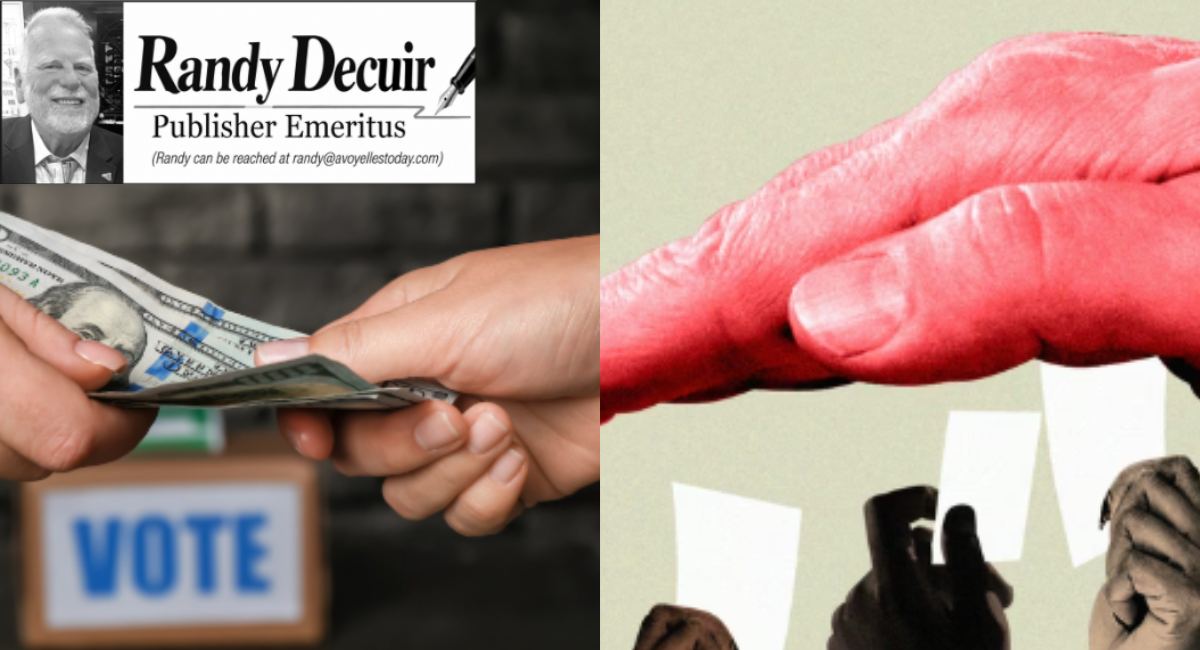
Opinion — Randy Decuir
Last week's column about vote buying brought an interesting observation from Marksville native Chris Roy Jr. He made a point worth considering: If we're going to talk about politicians buying votes, we also need to talk about efforts to keep people from voting altogether. Historically, vote buying has been associated with political machines seeking support, while efforts to restrict voting have taken different forms across generations. Today, debates over voting restrictions often divide along political lines, with Republicans emphasizing election security and Democrats warning about voter suppression.
But beneath those arguments is a question that should concern everyone: Who gets to vote, and who gets left out? As Chris put it, “At least with vote buying, they were trying to get people to exercise their right to vote. Now, they're trying to stop people from exercising it at all.” Chris also raised concerns about Louisiana sharing voter registration information with federal authorities. While election officials say such efforts help maintain accurate voter rolls, critics worry about privacy and the possibility of eligible voters being affected.
Not a new thing
Voter suppression is hardly a modern invention. During America's early years, voting rights were largely restricted to white men, often with property qualifications. Although those restrictions gradually disappeared, other Americans continued facing barriers to the ballot. Following Reconstruction, Southern states used poll taxes, literacy tests and grandfather clauses to prevent Black citizens from voting while protecting many white voters from similar restrictions. Where laws fell short, intimidation and violence often followed.
Avoyelles Parish was not immune. During the 1890s, a group known as the White Caps became associated with intimidation, violence and property destruction. Accounts describe fires and threats that contributed to Black families leaving the parish, with some eventually settling in Oklahoma. Local history also remembers Judge A.V. Coco of Marksville for standing against the White Caps, a chapter associated with his rise in Louisiana politics and eventual service as attorney general.
Politics, Avoyelles style
Of course, Louisiana politics has always had its share of colorful episodes. Back in the 1930s, Gov. Huey P. Long accused Marksville Mayor E.M. Laborde of attempting to disrupt one of his campaign speeches on the courthouse steps by sounding the town fire alarm. Imagine Huey Long addressing a crowd in Marksville when the fire alarm suddenly interrupts him. Laborde later issued a statement in this very newspaper denying any involvement.
Whether political mischief or unfortunate timing, the incident remains a reminder that Avoyelles politics has never lacked personality. But interrupting a speech and interfering with someone's right to vote are two very different matters.
Progress and the pendulum swing
The Voting Rights Act of 1965 marked a turning point, prohibiting discriminatory voting practices such as literacy tests and establishing federal oversight in jurisdictions with histories of discrimination. Avoyelles Parish experienced historic changes during the civil rights era. Sheriff F.O. “Potch” Didier hired the parish's first Black deputy, while Howard Desselle became an important figure in local voter registration and civil rights efforts.
In 2013, the U.S. Supreme Court struck down the formula determining which jurisdictions required federal approval before changing voting procedures. The decision did not eliminate the Voting Rights Act, but it weakened one of its principal enforcement mechanisms. Since then, states have debated stricter voter identification requirements, early voting, mail-in ballots and polling-place access. Supporters argue such measures protect election integrity, while opponents warn that some create unnecessary barriers for elderly, disabled, rural and lower-income voters.
Not every election rule amounts to voter suppression, but neither should restrictions escape scrutiny. There is a difference between protecting an election and making participation unnecessarily difficult.
A cynical question for the ages
Years ago, Louisiana political commentator John Maginnis visited Randy Dupuy's civics class at Marksville High School and offered a memorable observation about politics and voting. As the story goes, Maginnis admitted he wasn't entirely convinced that encouraging universal voter registration was such a wonderful idea. Then came a mischievous bit of classic Louisiana political wisdom:
“You think the country is bad now? Just think how bad our leaders could be if everyone voted.”
It was the kind of remark that could get a classroom laughing while leaving everyone with something to think about. Behind the humor, however, is a serious question about who gets to participate in democracy. Democracy has never promised that voters will always choose wisely. It guarantees something more important: that eligible citizens have the opportunity to make that choice themselves.
Buying someone's vote corrupts that choice, while unjustly preventing someone from voting takes the choice away entirely. Whether the obstacle is money, intimidation or unnecessary restrictions, the principle should remain the same. We should be trying to earn people's votes, not buy them — and certainly not keep them from voting.
Comments ()