Hope Out of Darkness: Solomon Northup Statue Unveiled at Marksville Courthouse
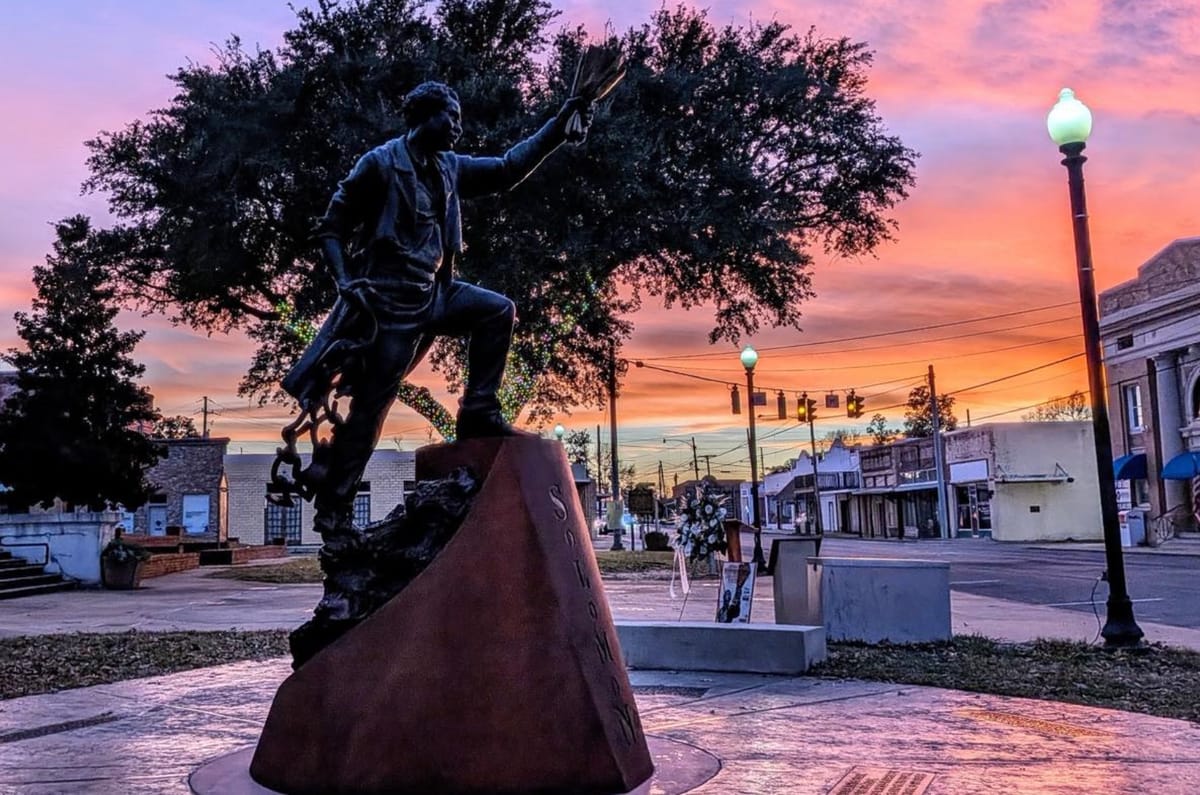
Solomon Northup statue unveiled at Marksville courthouse, returning a national
story to its Avoyelles roots: Marksville, Louisiana.
On the same courthouse square where justice once corrected one of the darkest wrongs in American history, more than 400 people gathered this week to witness a powerful moment come full circle.
Hope Out of Darkness, the first sculpture created in honor of Solomon Northup, was officially unveiled at the Avoyelles Parish Courthouse, marking the exact place where Northup regained his freedom in 1853 after twelve years of enslavement.
The ceremony returned a nationally known story to its rightful home, firmly anchoring it in the soil and history of Avoyelles Parish.
Northup’s life is one of the most documented and compelling narratives of slavery and freedom in the United States. Born a free Black man in New York in 1807, he was kidnapped in 1841 while traveling for work, drugged, and sold into slavery in Washington, D.C. He was sent to Louisiana, where he spent twelve years enslaved on plantations along the Red River region, including what is now Avoyelles Parish. Despite the brutality he endured, Northup never abandoned the belief that truth and law could restore his freedom. That belief ultimately led him to Marksville.
The Avoyelles Connection
In 1852, while enslaved near Marksville, Northup met Samuel Bass, a carpenter who opposed slavery. Bass secretly agreed to help and mailed letters from Marksville to contacts in New York, setting in motion the legal effort that would free Northup. Those letters reached officials who arranged for attorney Henry B. Northup to travel to Louisiana with official documentation proving Solomon Northup’s free status.
Upon arriving in Marksville in early January 1853, Henry Northup worked with local attorney John P. Waddill to locate Solomon Northup and present the necessary legal proof. The case was brought before a judge at the Avoyelles Parish Courthouse, where the documentation was reviewed and Northup was formally recognized as a free citizen who had been unlawfully enslaved. On January 4, 1853, Solomon Northup walked out of the Marksville courthouse a free
man. The statue now stands just steps from where that decision was made.
A Story known Worldwide
Shortly after returning to New York, Northup published Twelve Years a Slave, a firsthand account of his kidnapping, enslavement, and eventual freedom. The book became one of the most influential slave narratives of the nineteenth century and remains a foundational historical work. Northup’s story reached a global audience in 2013 through the Academy Award winning film 12 Years a Slave, which renewed interest in his life and experiences. While the film portrayed the harsh realities of slavery across Louisiana, the final chapter of Northup’s story, his legal emancipation, unfolded in Marksville. The statue permanently connects that widely known story to its Avoyelles Parish conclusion.
Meaning Carved in Bronze
Titled Hope Out of Darkness, the bronze sculpture depicts Northup standing upright, holding broken chains in one hand and his freedom papers raised in the other. During the ceremony, the sculptor explained that every element of the statue carries meaning. The broken chains represent the end of bondage. The papers symbolize both Northup’s legal freedom and the written words that preserved his story. The orientation of the statue and the handprints incorporated into the work reflect movement forward, dignity, and the lasting imprint of Northup’s experience.
Viewed from a distance, the statue presents Northup as resolute and forward moving. Closer inspection reveals physical details that acknowledge the suffering he endured, reinforcing that freedom was achieved through perseverance and the rule of law.
National Tour
Before returning home before its permanent installation in Marksville, Hope Out of Darkness traveled on a national tour, appearing at historically significant locations in Louisiana and New York connected to Northup’s life. The tour allowed audiences across the country to engage with his story before the sculpture returned to the place where his freedom was restored.
Community Effort and Leadership
The project was led by the Solomon Northup Committee for Commemorative Works. Committee members include Jim Theus, Jacques Goudeau, Larry Wilmer, Allen Holmes, Charles Riddle III, Nealie Hale, Wilbert Carmouche, and Melissa Howell. Board members James Graves Theus Jr. and Susannah Finch Theus also participated in the project’s leadership and organization.
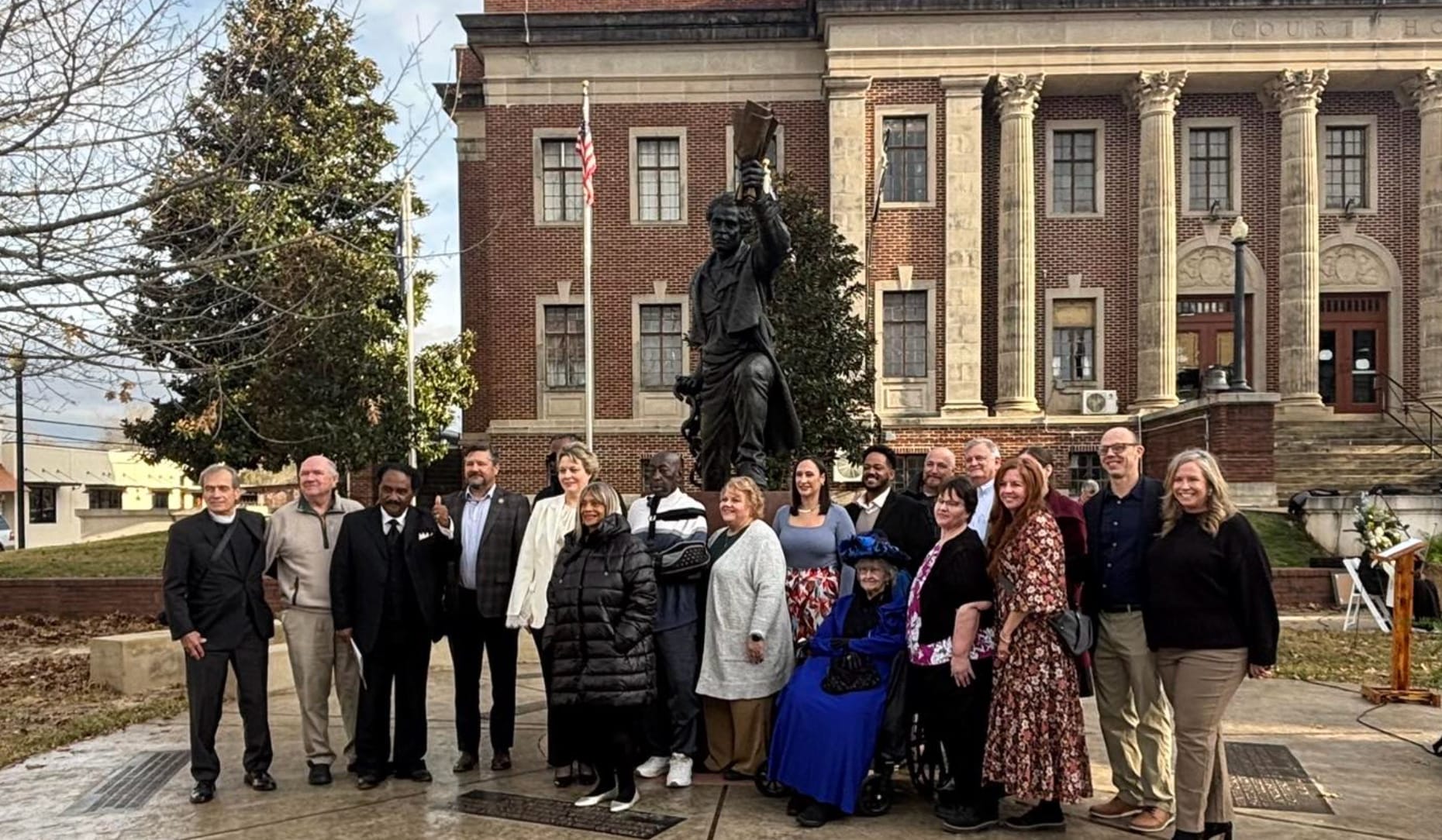
The unveiling ceremony featured remarks from Northup descendants, committee members, and representatives of state leadership. A representative from the Lieutenant Governor’s office addressed the crowd, and a proclamation from Governor Jeff Landry was delivered by State Representative Daryl Deshotel. Members of Northup’s family then joined together to remove
the veil from the statue, drawing sustained applause from the crowd.
Charles Riddle III, Avoyelles Parish District Attorney and a member of the committee, emphasized the deeper significance of the event.
“This is about our justice system in Avoyelles Parish working,” Riddle said. “Even though we were a slave parish in a slave state, we still did the right thing and set free a man who should never have been a slave. It was great to see such a wonderful crowd of so many people turning out for this event.”
A Permanent Reminder
With Hope Out of Darkness now standing on the Marksville courthouse square, Solomon Northup’s journey comes full circle. His story, known around the world, is permanently rooted in the place where justice prevailed. The statue serves as both a memorial and a teaching point, reminding future generations that even in the darkest chapters of history, the law, when applied
with courage, can still do what is right.
Comments ()