
How Much More Can They Take?? Avoyelles Farmers Face a Brutal 2026
By Avoyelles Today Staff
For farmers across Avoyelles Parish, 2026 has brought little room to recover.
Drought, a late freeze, destructive hail and wind, and severe flooding have hit local agricultural producers one after another — all while farmers continue to face rising production costs and pressure from lower commodity prices.
Justin Dufour, Agronomy Agent and Parish Chair, recently described the year as one marked by repeated challenges that have tested local producers at nearly every stage of the growing season.
“While adversity is nothing new in agriculture, the frequency and timing of these events have tested the resilience, adaptability, and determination of local producers unlike any season in recent memory,” Dufour wrote.
Trouble Before Planting
The difficulties began before many crops were even established.
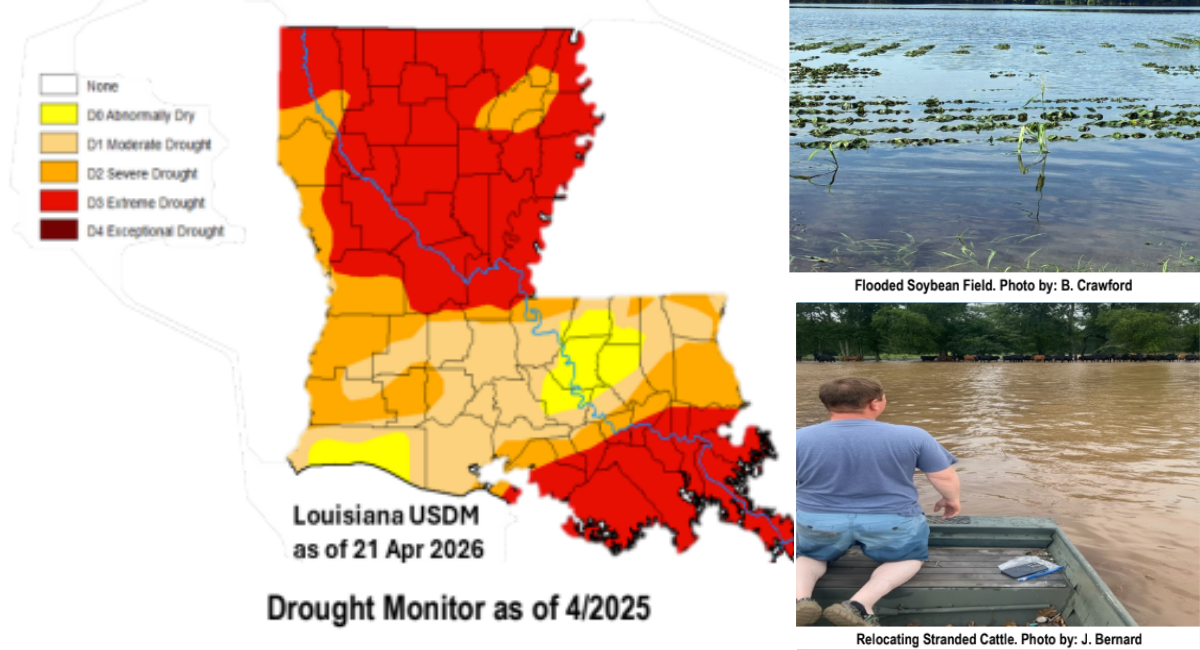
Late winter and early spring brought persistent dry weather, with portions of the parish reaching D-3, or Extreme Drought, conditions. The lack of moisture created concerns for both row crop and livestock producers as planting season approached.
Farmers faced questions about seedbed conditions, crop emergence and future yields, while livestock producers dealt with slow pasture growth and a greater need for supplemental feeding.
Then, on March 17, temperatures dropped below critical levels following several weeks of warmer weather.
The late freeze damaged crops and vegetation that had already begun growing. According to Dufour, roughly 40% of Avoyelles Parish’s corn crop had to be replanted.
Thousands of Acres Hit by Severe Weather
Less than two months later, another major setback arrived.
On May 8, severe weather brought hail, damaging winds and heavy rain to portions of Avoyelles Parish. Hail damaged plants and reduced stands in fields, while winds lodged crops, damaged infrastructure and broke limbs in pecan orchards.
Dufour estimated that roughly 10,000 acres suffered damage, with approximately half considered a complete loss.
For producers who had already invested heavily in their crops — and in some cases had already replanted following the freeze — the storm meant another round of assessing losses and determining whether fields could recover.
Flooding Delivers Another Blow
Then came June 18.
Tropical Storm Arthur brought excessive rainfall and severe flash flooding to the area, leaving water standing in fields during a critical period of the growing season.
Waterlogged soils restricted root growth and prevented farmers from getting into fields for important work, including fertilizer, herbicide and crop protection applications. Equipment access became limited, putting some producers weeks behind schedule.
Livestock operations were affected as well, with muddy conditions, damaged fencing and declining pasture quality adding to the difficulties.
“The storm compounded the effects of earlier weather events, leaving many producers to wonder what additional challenges the season might bring,” Dufour wrote.
The Cost Goes Beyond the Crops
The weather is only part of the problem.
Farmers are also operating in an increasingly difficult financial environment. Dufour pointed to pressure on commodity prices at the same time producers are paying more for seed, fertilizer, fuel, equipment, repairs, labor and other necessities.
For farms already operating on narrow margins, losing production to drought, freezes, storms and flooding makes that equation even harder.
“The financial equation has become increasingly difficult: higher costs to grow a crop combined with lower market prices at harvest leave little room for profitability,” Dufour wrote.
That pressure can mean delayed equipment purchases, postponed improvements and difficult decisions about how — or whether — to invest in the future of an operation.
But the impact of a year like 2026 cannot be measured only in acres, yields or dollars.
Dufour also called attention to the emotional toll of watching months of work and investment damaged by circumstances farmers cannot control.
“Farming is more than a business; it represents years of dedication, family investment, and a commitment to stewarding the land for future generations,” he wrote.
Despite everything the year has brought, Avoyelles Parish producers have continued to adapt, support one another and move forward.
There is still hope that better conditions through the remainder of the growing season could help offset some of the losses. But 2026 has already served as a reminder of just how much uncertainty local farmers carry each year.
Weather extremes, rising costs, uncertain markets and shrinking margins may be putting unprecedented pressure on local agriculture, but as Dufour noted, Avoyelles Parish’s agricultural community continues to show its resilience — one setback at a time.


Comments ()