🚨 Important Update: Chronic Wasting Disease Control Area Expansion in Louisiana! 🦌
Chronic Wasting Disease
Control area expands, portions of Avoyelles Parish affected
By Dr. Jay Callegari
The Louisiana Department of Wildlife and Fisheries has expanded its Chronic Wasting Disease Control Area following confirmation of a CWD-positive white-tailed deer harvested on the Richard K. Yancey Wildlife Management Area in Concordia Parish. As a result, portions of Avoyelles Parish are now included in new disease management zones.
State officials stress that Chronic Wasting Disease has not been detected in Avoyelles Parish. The expansion is intended to slow the spread of a disease that wildlife experts say cannot be cured or eliminated once it becomes established.
What Is Chronic Wasting Disease?
Chronic Wasting Disease, commonly known as CWD, is a fatal neurological disease that affects deer and related species. The disease attacks the brain, causing infected animals to lose weight, behave abnormally, drool excessively, lose coordination, and eventually die. There is no cure, no vaccine, and no treatment. Once a deer becomes infected, it will not recover.
CWD is not caused by bacteria or a virus. It is caused by a malformed protein known as a prion. These prions damage brain tissue and are uniquely dangerous because they do not break down easily.
Why CWD Cannot Be Killed
One of the most troubling aspects of Chronic Wasting Disease is that normal methods of destroying disease do not work.
- Cooking does not destroy prions
- Freezing does not destroy prions
- Prions can persist in soil and vegetation for years
Once prions enter the environment, deer can become infected simply by grazing in contaminated areas. This is why wildlife officials focus heavily on prevention and containment rather than eradication. LDWF has stated that once CWD becomes established in a region, it is considered a long-term wildlife management issue, not a short-term outbreak.
Why Feeding Deer Increases the Risk
LDWF officials emphasize that artificial feeding accelerates the spread of CWD by forcing deer to congregate unnaturally. At bait piles, feeders, and mineral sites, deer share saliva, bodily fluids, and direct contact. If even one deer is infected, prions can be deposited on feed or soil and passed to others.
LDWF Deer Program Manager Johnathan Bordelon, in an interview with Avoyelles Publishing, explained the reasoning behind the feeding restrictions and addressed the broader implications of the recent detection:
“When deer are artificially congregated at feeding sites, diseases like CWD can spread much faster. Reducing that congregation is one of the most effective tools we have to slow transmission.”
Bordelon also addressed the broader implications of the recent detection:
“The detection of CWD in Concordia Parish is discouraging news. Concordia is the third parish where the disease has been confirmed in a wild deer. Based on current disease surveillance, disease prevalence appears to be very low at this time. The transmissibility and environmental persistence of CWD does threaten the long-term viability of deer. Early detection and mitigation does offer the best possible outcome.”
How Avoyelles Parish Is Affected
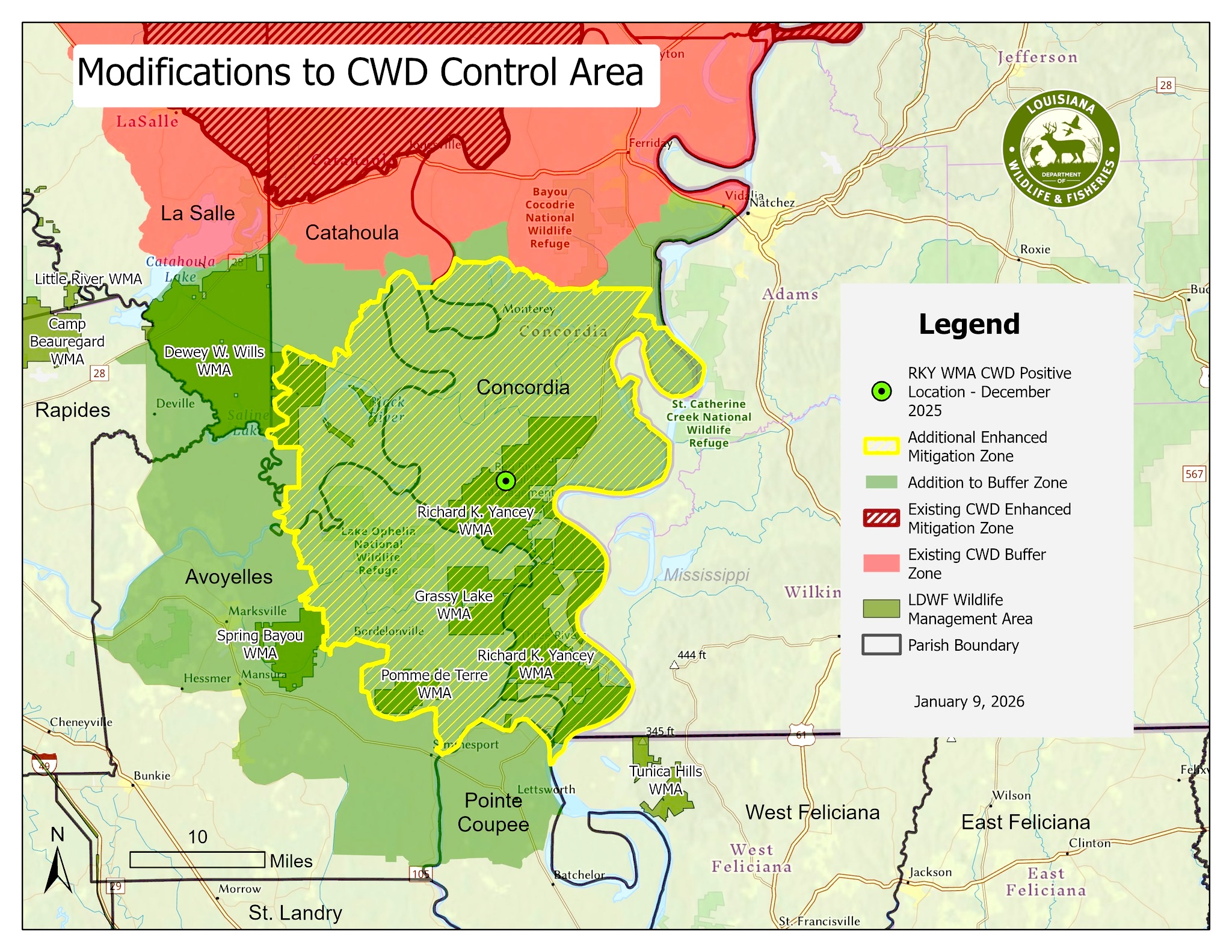
Only specific portions of Avoyelles Parish fall within the expanded control area. The LDWF map shows the affected sections primarily along the eastern side of the parish.
According to the map legend: - Yellow hatched areas are part of the Enhanced Mitigation Zone, where feeding is fully prohibited - Light green areas are part of the Buffer Zone, where limited feeding methods are allowed - Dark green areas represent Wildlife Management Areas
Inclusion in a zone does not mean disease is present locally. It means the area is being managed proactively to prevent spread.
Deer Carcass Transport Rules Apply to the Entire Control Area
Deer carcass transport rules apply throughout the entire CWD Control Area. Hunters may move deer anywhere within the CWD Control Area. However, only approved deer parts may be transported outside of the CWD Control Area.
Approved parts include: - Deboned meat - Cleaned skull plates - Antlers - Hides - Finished taxidermy mounts
There is an exemption available through an electronic waiver that allows hunters to transport deer heads to a taxidermy business outside the CWD Control Area for taxidermy purposes. Hunters may transport deer heads to taxidermy businesses within the CWD Control Area without a permit.
These carcass movement provisions are effective immediately under the Declaration of Emergency.
Feeding and Baiting Rules by Zone
Feeding and baiting restrictions apply only to the Enhanced Mitigation Zone and the Buffer Zone.
- Within the Enhanced Mitigation Zone, all baiting and feeding of deer is prohibited.
- Within the CWD Buffer Zone, hunters may broadcast bait, but only by non-stationary methods that utilize mechanical or electronic broadcast systems.
Non-stationary methods include: - Mobile broadcast techniques such as tractor-mounted spreaders or ATV-mounted spreaders - Hand broadcasting while walking
Stationary feeders, pile feeding, gravity feeders, trough feeders, mineral blocks and salt licks are not allowed. The purpose of these restrictions is to reduce prolonged congregation of deer at fixed locations while still allowing limited hunting practices.
New Rules Begin February 1, 2026
The Declaration of Emergency is currently in effect and applies immediately to deer carcass movement within and beyond the CWD Control Area. Hunters must comply with approved carcass transport requirements at this time.
Effective February 1, 2026, feeding will be banned in the Enhanced Mitigation Zone. Feeding in the Buffer Zone will be limited to approved non-stationary broadcast methods. There is no statewide feeding ban.
The Declaration of Emergency is effective for 180 days. Permanent rules may follow through the Louisiana Wildlife and Fisheries Commission. Additional guidance and regulatory information is expected to be released in the weeks and months ahead.
What Hunters Should Know
There is no confirmed evidence that CWD infects humans. However, health officials strongly advise not consuming meat from infected deer.
Free testing is available, and hunters are encouraged to follow feeding regulations, properly dispose of carcass remains where harvested and report deer showing extreme weight loss or abnormal behavior.
LDWF notes that a clear overview of these regulations is available in the Quick Guide to Hunting in a CWD Control Area on the department’s Chronic Wasting Disease webpage. More information is available at wlf.louisiana.gov/page/cwd.
Protecting a Way of Life
Deer hunting is a longstanding tradition in Avoyelles Parish. LDWF officials say these measures are intended to protect the deer herd, not punish hunters.
By reducing artificial congregation, limiting movement of infected material and expanding surveillance, wildlife officials hope to slow the spread of a disease that, once established, never truly goes away.


Comments ()