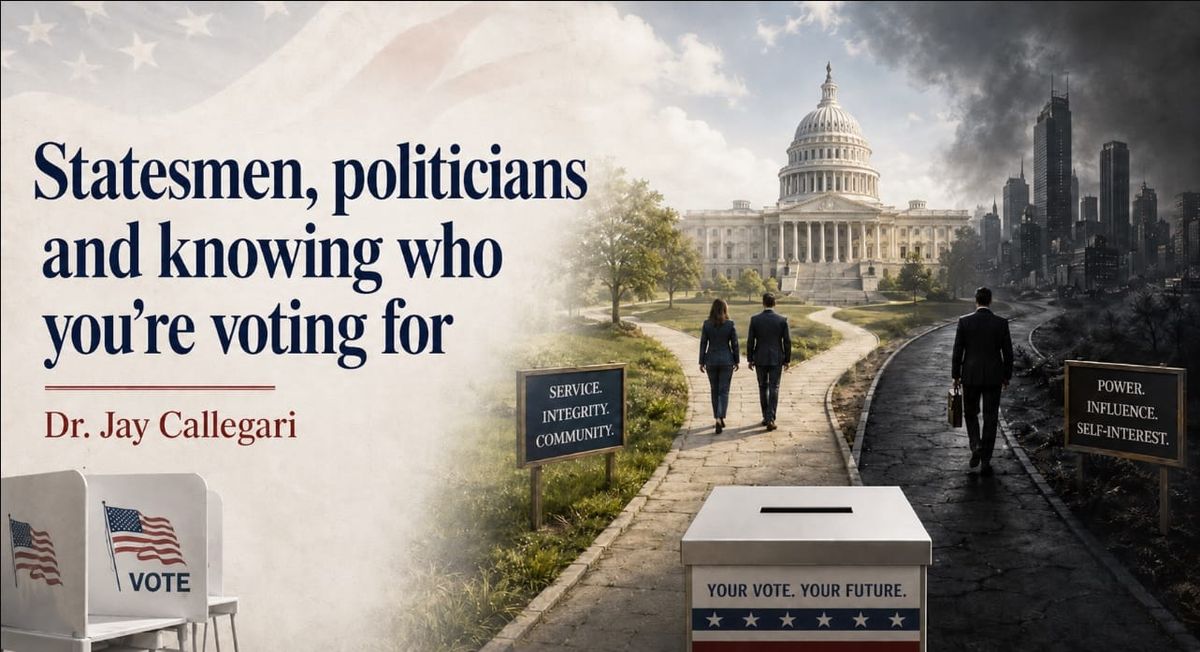
Statesmen, politicians and knowing who you’re voting for
Dr. Jay Callegari
This is shaping up to be a pretty hot political season, both here at home and across the country. Candidates are making their rounds, promises are being made, and voters will once again decide who they want making decisions about their tax dollars, communities and the policies that affect their everyday lives. After spending a number of years in and around politics myself, I thought this might be a good time to share something my experience has taught me about the difference between a politician and a statesman.
To me, the difference is mostly about why someone wants the office. A statesman wants the position because of what he or she can do with it. The office is an opportunity to serve, solve problems and hopefully leave something better than it was before. A politician, in the negative sense of the word, begins to want the office because of what the office does for that person. The title, recognition, influence and staying in office can eventually become more important than the reason for running in the first place.
The distinction isn’t always simple because, ironically, an effective statesman has to learn how to be a politician. You have to communicate, build relationships, persuade people, campaign and sometimes tell people what you’ve accomplished. The trick is doing those things without allowing politics to become who you are.
I learned pretty quickly in elected office that most of the work happens where nobody sees it. There are meetings, phone calls, budgets to study, questions to ask and countless small decisions that never make Facebook or the newspaper. At some point I realized that if I never told people about the work being done, how were they supposed to know?
That creates a Catch-22 for anyone who doesn’t like drawing attention to their own accomplishments. You can quietly do good work, but if the public never hears about it, they may reasonably believe you haven’t done much at all. So you have to communicate what is being done while hopefully giving credit to everyone involved. I came to realize that isn’t necessarily self-promotion. It is also part of being transparent and accountable to the people you represent.
The danger comes when the office itself becomes part of someone’s identity. There is a tremendous difference between wanting an office because of what you can do with it and wanting an office because of what the office does for you. Titles, attention and influence can be hard to give up, and somewhere along the way a person can begin confusing respect for the office with importance belonging to the person holding it.
In our system of representative government, elected office isn’t something we own. The authority belongs to the people, and they loan some of it to us for a limited period of time. Once an officeholder begins thinking, “I deserve this position,” rather than, “I’ve been given the privilege of serving in this position,” the way decisions are made can change. “What is best for the people?” can slowly become, “What will this do to me politically?”
I’ve always tried to make decisions based on the issue in front of me rather than who is standing beside me or against me. If someone I normally disagree with has a good idea, I should be able to support it. If someone I normally agree with has a bad idea, I should be able to oppose it. Government requires compromise, and not every disagreement needs to become a battle. There is a difference between compromising on preference and compromising on principle, and knowing that difference is part of governing.
Being a statesman also doesn’t mean making everyone happy. A good elected official should listen carefully to people who disagree and make a sincere effort to understand their argument. Understanding another point of view doesn’t require agreeing with it. After listening, you still have to make the decision you believe is right and live with the consequences. If every decision is based on whether someone might vote against you next time, eventually you aren’t representing the people anymore. You’re representing your own reelection.
Politics naturally attracts confident and ambitious people, and there is nothing necessarily wrong with that. It takes confidence to stand before your neighbors and tell them you believe you’re the person they should elect. The problem is that the qualities that help someone win an election aren’t always the qualities that help someone govern well.
We often elect the person who can work a room rather than the person who can work through a complicated problem. Charisma is easy to see, while judgment, preparation, problem-solving ability and the willingness to make difficult decisions are harder to measure during a campaign.
There is nothing wrong with political ambition, either. Someone can want to be mayor, state representative, senator or governor and still be a statesman. The important question is why. Does that person want greater office because it provides a greater opportunity to build something, fix something or help people, or does that person simply need another title?
As we decide who deserves our votes this political season, maybe we should look beyond who has the most charisma, who gives the best speech or who tells us exactly what we want to hear. Look at how that person thinks, what he or she has accomplished, how the candidate treats people who disagree, whether credit is shared with others and whether that person is willing to make a difficult decision even when it may not be politically popular.
Most importantly, I think we should ask one simple question about anyone asking us for our vote: Does this person want to be somebody, or does this person want to do something?
The answer may tell us whether we’re electing a politician or a statesman.



Comments ()