
The Evolution of Phones: From Flip to Smart!
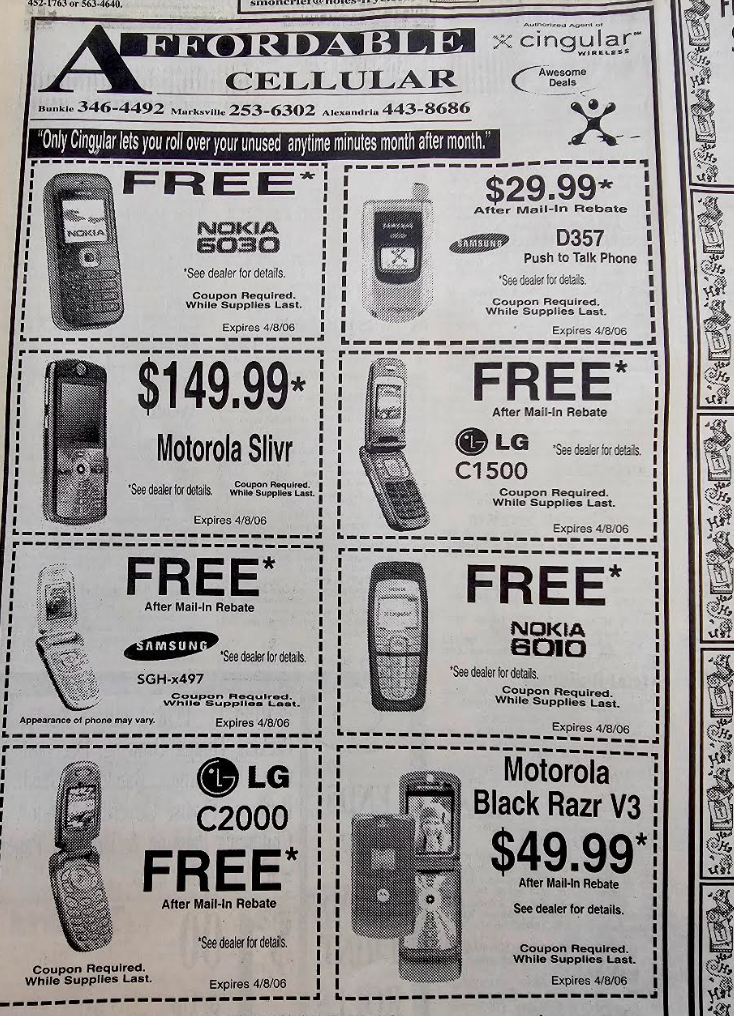
Pictured on left: A 2006 advertisement from the Bunkie Record.
The Cingular Wireless advertisement highlights a time when flip phones ruled the market, offering basic calling and texting features for as little as free after rebate. Today’s smartphones have replaced not only those early devices, but also cameras, radios, maps, and more, all within a single pocket-sized screen.
Pocket-Sized Revolution:
From flip phones to all-in-one lifelines
A recently uncovered advertisement from 2006 offers a glimpse into a time when cell phones were simple, practical tools rather than the all-encompassing devices we rely on today. The ad, promoting deals from Cingular Wireless, showcases a lineup of flip phones and basic mobile devices that were once considered cutting edge. Models like the Motorola Razr V3, LG C1500, and Nokia 6100 were marketed as must-have gadgets, with prices ranging from free after rebate to around $149.99. At the time, even the most advanced phones focused on the basics. They made calls, sent text messages, and occasionally captured a low-resolution photo.
Color screens and compact designs were enough to impress, and the slim Motorola Razr stood out as a premium option. Service plans reflected that simplicity. One featured offer advertised $29.99 per month with rollover minutes, allowing unused minutes to carry into the next billing cycle. Unlimited data was not part of the conversation, because mobile internet had yet to become a central part of everyday life.
Fast forward to 2026, and the difference is hard to ignore. Today’s smartphones are no longer just phones. They have quietly replaced an entire collection of everyday items. What once required a camera, a radio or CD player, a televised weather report, and a folded paper map in the glove box, can now be handled by a single device that fits in a pocket.
Beyond convenience, smartphones have also become powerful tools for accessibility. Features like speech-to-text, text-to-speech, and live captions help bridge communication gaps for individuals who are hearing impaired or have difficulty reading. Tasks that once required assistance can now often be managed independently with a few taps on a screen.
Consumer priorities have shifted just as dramatically. Instead of counting minutes, users now focus on data speeds, coverage, and storage capacity. Unlimited talk and text are standard, while data plans support everything from streaming entertainment to remote work and daily communication. The transformation is not only technological, but cultural. In 2006, a cell phone was a convenience. Today, it is a constant companion. It serves as a camera, a map, a source of news, and a connection to the world, all in one place.
Looking back at this advertisement highlights just how quickly that shift has taken place. Devices that once felt advanced now seem almost quaint. Yet for many, there is still a sense of nostalgia in remembering the satisfying snap of a flip phone and a time when life felt just a little less connected and a little more present.
One local resident, Haley, remembers that era fondly.
“I loved my Razr,” she said. “I’d go back to it in a heartbeat. If only we could all go back and see how good we had it.”
For readers in Avoyelles, this small piece of advertising history tells a much larger story. It is not just about how cell phones have changed, but how everyday life has changed right along with them.
Looking even further back, there was a time when communication meant a shared landline, often mounted on the kitchen wall, with a long cord stretched as far as it would go for a bit of privacy. Remember dialing just four digits to reach a neighbor, that’s when everyone in town knew each other’s number by heart.
The day Cottonport added the 876 prefix marked a shift of its own, a small but memorable step toward a growing and more connected community.
From party lines and rotary phones to flip phones and now smart phones, each generation of technology has brought people closer while quietly reshaping how we keep in touch.
What once required patience, planning, and sometimes a little waiting has become instant and constant. And while today’s devices can do more than ever imagined, it is those small memories, the ring of a landline, the feel of a rotary dial, or the snap of a Razr, that show just how far technology has come.



Comments ()